
How Much Should We Compensate Local Elected Officials?
Recent articles exposing local school board compensation raise the question.


Two recent articles (OC Register & Jon Fleischman’s So, Does it Matter Substack) have spurred debate about the appropriate level of compensation for our local elected officials. The articles point out that the bulk of the compensation for local school board trustees in Orange County lies in health care benefits that range up to $55,000 per trustee per year as opposed to attendance-based stipends, which range from $5,000-$10,000 per year.
As a a public corruption prosecutor and someone who has waded into school board politics, I have given some thought to local elected official compensation. There are strong competing interests when it comes to this issue.
On the one hand, we want compensation to be high enough that good people are attracted to these positions and less susceptible to undue influence. When taken seriously, these are legitimately tough jobs that require dedication and diligence. Individuals shouldn’t need to be independently wealthy to serve.
On the other end of the spectrum, excessive compensation would risk creating a professional class of local politicians more concerned with enriching themselves than serving their constituents.
What is the right balance?
The Compensation
Below, I reproduce the OC Register’s chart on school board trustee compensation in Orange County. The multiple entries per board appear to represent individual trustees.
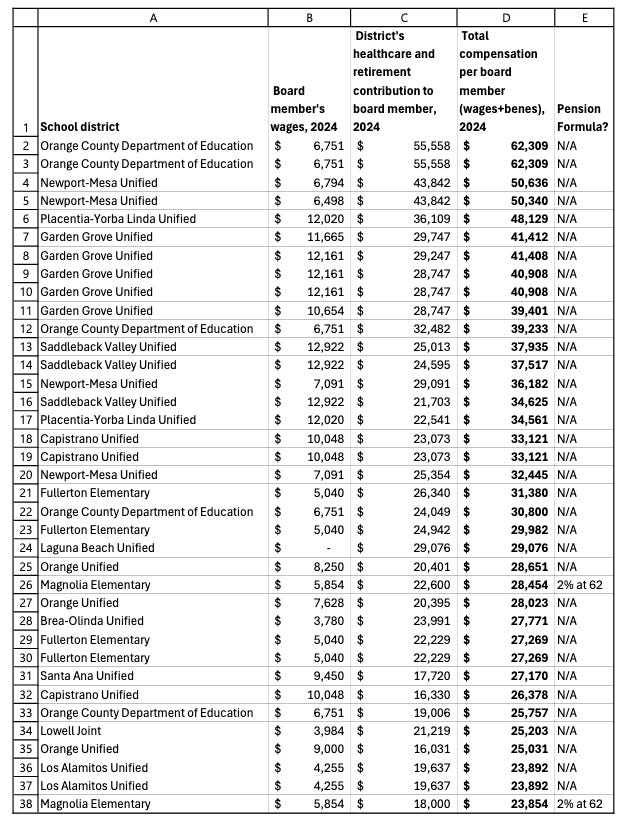
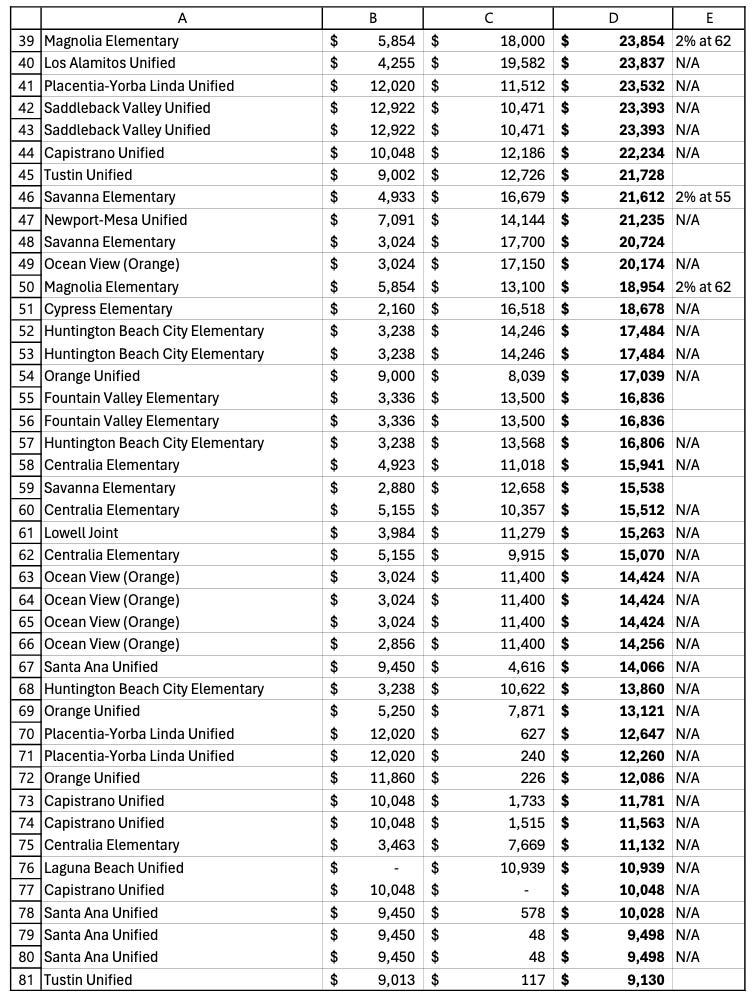
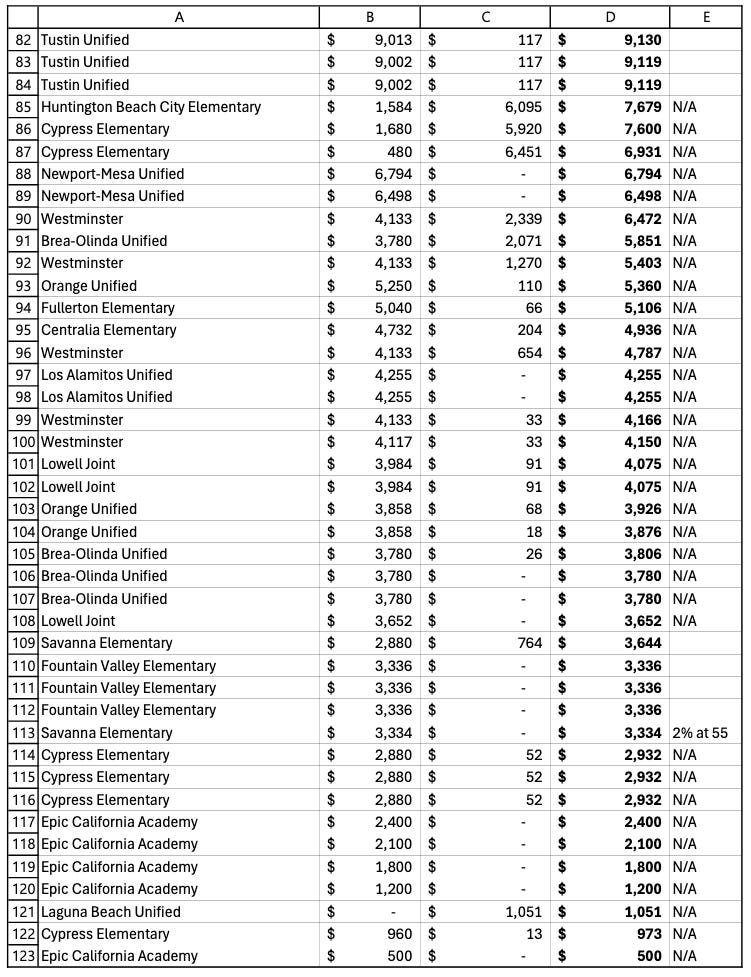
According to the article, board members are offered the same health benefits package as employees—which is apparently standard practice. There is wide variance, as board members who may have health benefits from outside employment decline benefits through the school districts they serve.
The Commitment
As the articles correctly point out, this compensation structure is not limited to school board trustees. Local elected officials including city council members, school board trustees, community college district trustees, water district board members, and other special district board members have similar compensation.
Although these positions are part-time, and individual responsibilities vary, here are some common features from a time/commitment perspective:
For school board trustees, about 10-20 hours per week of school board-related work seems to be the consensus. However, I know many trustees and city councilmembers exceed this commitment;
Personal attendance not only at official board meetings but frequent ad hoc meetings and community events, probably at least one or two per week;
Give up privacy. All local elected officials are public figures subject to enhanced scrutiny in their public and private lives. This includes mandatory public reporting of income, gifts, stocks, and real estate owned in the jurisdiction.
Of course, these commitments do not include the fundraising and public outreach efforts necessary to get elected in the first place!
What is the right balance?
When I ran for a position on the Newport-Mesa Unified school board in 2024, I looked at the entire endeavor—from running for office to potentially serving on the board—as volunteering my time.
First, I already had healthcare through my full-time employment, so that was a non-issue. Second, the value of my time and effort spent campaigning, let alone potentially serving on the board, would have dwarfed the roughly $7,000 yearly stipend. For all intents and purposes, school board trustee would have been a volunteer position for me that would require a sacrifice of privacy and free time with my family.
Instead, as a parent, the twin goals of restoring our schools to academic excellence and empowering parents motivated my run (and this newsletter!).
I suppose this means we should evaluate local elected official compensation on a case by case basis. After all, every candidate for local office will have his or her own individual financial picture. In each circumstance, we should evaluate whether the individual appears to be motivated by serving the public or his or her own financial interests.
I think this is a thoughtful analysis. But I think at the end of the day we also need to ask whether the appropriate way to provide compensation for a part-time endeavor is by providing health care benefits that traditionally are reserved for full-time employment? And whether that really hides the compensation? Also, it Is not insignificant that If the elected trustees get the same benefits as the employees, they are tremendously Incentivized to Increase the size and scope of employee benefits. By the way, I have had several elected officials tells me that they are tired of serving but the benefits are "just to good to give up" -- so there's that.
Jon, I absolutely agree. As one of these listed (you can find me as #89 here on the 3rd page of this list), the fact that I have health insurance through my husband’s employer makes this, as Phil mentioned, truly like volunteer work…
My ~ $6k goes nearly entirely to childcare costs to be able to attend meetings/events/etc. I seemingly lose money by serving… Others who get the health benefits for their families (it is actually an incentive that is factored into the decision for many electeds) makes it such a discrepancy…For members of the same board, same position, we have vastly different financial benefits from holding the same post.
Also the variance on base-rate (not including health) by district is interesting… I’d love to see an analysis of that first column next to column with the size of district/budget…